honey
Last Updated : Apr 05,2024
What is Honey, (Madh) ? Glossary | Uses, Recipes with Honey |
Viewed 25871 times
Also known as
Shaed, Madh, Shahed
What is honey?
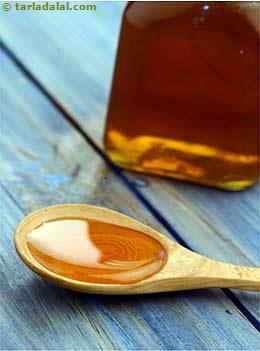
Honey is a sweet substance produced by honey bees and some similar species from the nectar of flowers. Honey gets its sweetness from the mono-saccharides fructose and glucose and has approximately the same relative sweetness as that of granulated sugar (97% of the sweetness of sucrose, a disaccharide).
Honey has attractive chemical properties for baking, and a distinctive flavour which some people prefer over sugar and other sweeteners. Generally, honey is classified by the floral source of the nectar from which it was made, or by the level of processing.
Pasteurized honey is honey that has undergone a pasteurization (heating) process. Pasteurization in honey reduces the moisture level, destroys yeast cells, and liquefies crystals in the honey.
Raw honey is honey as it exists in the beehive or as obtained by extraction, settling or straining without adding heat above 120°F. Raw honey contains some pollen and may contain small particles of wax.
Strained honey is honey which has been passed through a mesh material to remove particulate material (pieces of wax, propolis, etc.) without removing pollen, minerals or valuable enzymes.
Ultrasonicated honey is honey that has been processed by ultrasonication, a non-thermal processing alternative for honey. When honey is exposed to ultrasonication, most of the yeast cells are destroyed.
Dried honey is honey in which the moisture has been extracted to create a completely solid, non-sticky version. This process is done in such a way that there are no additives or binding agents of any kind added, which keeps the honey 100% natural. Dried honey is commonly used to garnish desserts.
Organic honey
.jpg)
Organic honey is gaining lot of preference nowadays. Manufacturers need to meet a set of organic standards and conditions at the time of honey production (set by an organic agriculture certification body), which include source of the nectar, honey bees foraging area, bees management, honey extracting process, transportation, processing temperature, and packaging materials. Honey which is organic has to be tested to guarantee that it does not contain any residues of pesticides or environmental pollutants. These standards vary from country to country.
Raw unpasteurised honey
.JPG)
What is raw unpasteurised honey?
The honey must be raw and unpasteurized, that means it is not heated, and importantly not filtered or processed.
Raw unpasteurised honey is made in India and easily available also on Amazon. If its organic honeys then it can be pasteurized and be processed. If you want honey to have as a healthy option to your diet, then you must buy the correct honey by reading the label on the honey bottle and this
Raw unpasteurized honey is far more expensive than organic or processed honey.
How to select honey
• Most commercially available honey is blended, meaning that it is a mixture of two or more honeys of different floral source, colour, flavour, density or geographic origin.
• Check the expiry date before buying.
• If possible, opt for organic honey. Organic honey refers to the honey or honey combs produced, processed, and packaged in accordance with national regulations, and certified as such by some government body or an independent organic farming certification organization.
• Make sure the honey is not too crystallised – which could mean that there is some adulteration or it has been refrigerated.
• Similarly, if you drop a spoon of honey in cold water, it should sink to the bottom and not dissolve. If it dissolves, it might be adulterated with sugar or jaggery syrup.
Culinary Uses of honey
• Honey enhances browning and crispness, and is hence great for glazing roasted and baked foods to promote surface browning.
• Honey is a flavour enhancer; it is a much-loved natural sweetener for hot teas and cold beverages, especially so when there are many varieties of honey to choose from.
• It provides texture and feel, and is an excellent addition to pastries and cakes.
• It prolongs shelf-life and is hence a natural preservative for pickles and sauces.
• Honey retains moisture, an essential ingredient for prolonging moisture retention in rich cakes.
• Honey provides binding due to its viscosity, and aids in shaping of desserts such as pastries, puddings and cakes.
• It adds colour, adding a delightful golden hue to sauces, dressings, jellies and frozen desserts.
How to store honey
• Store honey in dark coloured bottles and keep them in a cool place in your kitchen cabinet.
Health benefits of honey
• With respect to carbohydrates, honey is mainly fructose (about 38.5%) and glucose (about 31.0%),making it similar to the synthetically produced inverted sugar syrup which is approximately 48% fructose, 47% glucose, and 5% sucrose. Honey's remaining carbohydrates include maltose, sucrose, and other complex carbohydrates
• As with all nutritive sweeteners, honey is mostly sugars and is not a significant source of vitamins or minerals.
• Honey contains flavonoids that help reduce the risk of some cancers and heart disease.
• Reduces ulcers and other gastrointestinal disorders.
• All honey is antibacterial, because the bees add an enzyme that makes hydrogen peroxide.
• Honey is superior in maintaining glycogen levels and improving recovery time than other sweeteners. Hence, it is good for athletes.
• Reduces cough and throat irritation.
• Some honeys have a low hypoglycemic index, and can be had by diabetics too.
• Honey is probiotic food as it contains large amounts of friendly bacteria.
• Honey is also believed to be good for the skin.

Soya
Missed out on our mailers?
Our mailers are now online!
View Mailer Archive
Privacy Policy: We never give away your email
REGISTER NOW If you are a new user.
Or Sign In here, if you are an existing member.

If your Gmail or Facebook email id is registered with Tarladalal.com, the accounts will be merged. If the respective id is not registered, a new Tarladalal.com account will be created.
Hi,

Click OK to sign out from tarladalal.
For security reasons (specially on shared computers), proceed to Google and sign out from your Google account.